What Size Grow Tent Is Best for 4 Plants?

Time:2026-09-21 Author:Liam
0%

Choosing the right tent begins with a practical question: “What size grow tent do I need for 4 plants?” The answer depends on plant variety, container width, lighting, and the space needed for airflow. Four compact herbs may fit comfortably in a 2-by-2-foot tent. Four larger fruiting plants usually need a 4-by-4-foot tent for healthier spacing and easier maintenance.

Dr. Bruce Bugbee, a plant physiologist and respected indoor-growing researcher, has emphasized, “The most important thing in growing plants is light.” His point matters here. A larger tent is not automatically better if the light cannot cover the entire canopy evenly. Measure each pot, then leave room between leaves and tent walls. That gap helps prevent crowded foliage and improves air movement.

Access matters, too. A 3-by-3-foot tent can work for four medium plants, but reaching the back corners may become awkward. I have found that growers often underestimate working space, especially after adding trays, fans, and a humidifier. Small details become annoying quickly.

A simple layout may use four 12-inch pots with a small central gap. Larger containers need more floor area. Leave clearance for cables and ventilation equipment. Do not force four plants into a cramped enclosure. Slower growth, shaded leaves, and difficult watering can follow.

This guide compares common tent sizes, usable floor space, lighting coverage, and plant-training needs. It also explains when a smaller tent saves money, and when extra room prevents expensive mistakes.
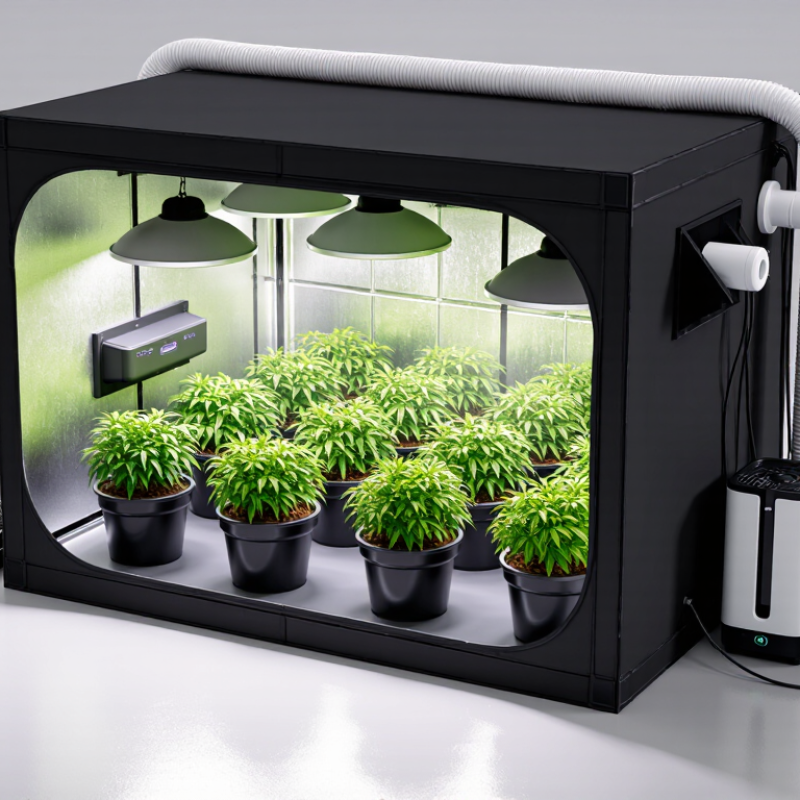
What Size Grow Tent Is Best for 4 Plants?

How Plant Size and Growth Style Determine Grow Tent Space

What Size Grow Tent Is Best for 4 Plants?

For four plants, a 4-by-4-foot tent offers 16 square feet of floor space. That sounds generous, but mature canopy size changes everything. University extension spacing guides commonly allow 18 to 24 inches for compact peppers and leafy vegetables. Four plants can fit comfortably with careful pruning and airflow. A 4-by-4 tent may feel crowded.

Size matters.

The Royal Horticultural Society recommends roughly 18 to 24 inches between many tomato plants, depending on cultivar and training method. Four large, bushy plants may therefore need a 5-by-5-foot tent, providing 25 square feet. Tall, upright plants use vertical space, while spreading plants consume valuable floor area. Trellising can improve organization, but it does not create extra root space or airflow.

I have seen growers measure pots, then forget the leaves. That mistake is easy to repeat. A 3-gallon container may occupy less space than its mature canopy. Leave clear gaps between plants, walls, and equipment. Poor spacing often causes shaded leaves, humid pockets, and difficult maintenance. The U.S. Department of Agriculture’s controlled-environment agriculture guidance also emphasizes managing light, temperature, humidity, and air movement together. For compact growth, choose 4-by-4 feet. For wide canopies or less aggressive training, 5-by-5 feet is more forgiving.

Comparing Tent Dimensions for Four Plants

What Size Grow Tent Is Best for 4 Plants?

For four compact legal plants, tent dimensions should match mature canopy size, not today’s seedlings. A 2 × 4-foot tent provides 8 square feet, or 2 square feet per plant. That footprint works for narrow herbs, leafy greens, or small ornamentals. However, access becomes awkward when foliage fills the corners. A 3 × 3-foot tent offers 9 square feet and gives each plant about 2.25 square feet. It is a practical middle ground.

A 4 × 4-foot tent provides 16 square feet, leaving roughly 4 square feet per plant. This extra space supports wider containers, safer airflow, and easier inspection. University extension guidance commonly stresses spacing for mature leaves and ventilation, rather than plant count alone. Indoor-lighting research also links productivity with daily light integral, often measured around 12–20 mol/m²/day for many indoor crops. The 2023 USDA Floriculture Crops Summary shows the scale and value of controlled-environment production, but it does not define one universal tent size.

Measure the canopy first.

Container width matters too. Four 12-inch pots can occupy nearly 4 square feet before leaves spread. In practice, a 3 × 3-foot tent suits compact plants, while a 4 × 4-foot tent offers a more forgiving layout. I would not automatically choose the largest option. Bigger tents can waste light and energy if the plants remain small. My first estimate may still be wrong without knowing cultivar, container size, and final height.

What Size Grow Tent Is Best for 4 Plants? - Comparing Tent Dimensions for Four Plants

Tent Dimensions Floor Area Recommended Plant Layout Suitable Plant Width Vertical Space Advantages Limitations Suitability for 4 Plants
2 × 2 ft
(61 × 61 cm)
4 sq ft
(0.37 m²)
Four small plants in compact containers, arranged in a 2 × 2 grid Approximately 10–12 in (25–30 cm) per plant Usually available in 4–6 ft heights Compact footprint; uses less growing medium, water, and lighting capacity Very limited root, canopy, and working space; airflow management can be difficult Only suitable for small, trained, or short-cycle plants
3 × 3 ft
(91 × 91 cm)
9 sq ft
(0.84 m²)
Four small-to-medium plants with approximately 18 in (46 cm) of space per plant Approximately 16–18 in (41–46 cm) per plant Commonly available in 5–7 ft heights Good balance between usable space and a relatively small footprint Can become crowded if plants are allowed to grow wide or if large containers are used Suitable for four compact or moderately trained plants
5 × 5 ft
(152 × 152 cm)
25 sq ft
(2.32 m²)
Four large plants with generous spacing and room for training or support structures Approximately 30 in (76 cm) or more per plant Commonly available in 6–7 ft heights Excellent access, air circulation, root-zone capacity, and room for larger containers Higher equipment requirements; unused space may reduce efficiency with small plants Best for large plants or growers who want extra working room
4 × 8 ft
(122 × 244 cm)
32 sq ft
(2.97 m²)
Four large plants in a single row or two rows with a central access area Approximately 30–36 in (76–91 cm) per plant Commonly available in 6–7 ft heights Provides substantial room for plant separation, equipment, and maintenance access Large footprint; higher setup cost and greater lighting and climate-control demands Usually more space than necessary unless plants are very large

Practical recommendation: A 4 × 4 ft tent is generally the most versatile option for four medium-sized plants. Choose a 3 × 3 ft tent for compact plants, or a 5 × 5 ft tent when larger containers, wider canopies, or additional working space are priorities.

Calculating Space for Lights, Ventilation, and Equipment

What Size Grow Tent Is Best for 4 Plants?

A 4-by-4-foot tent is usually the most practical choice for four legal container plants. It provides 16 square feet of floor area, leaving room for pots, plant gaps, and basic maintenance. A 3-by-3-foot tent can work, but the corners become crowded quickly. My first layout mistake was measuring only the plants, not the equipment.

Light placement needs equal attention. The DesignLights Consortium’s Horticultural Lighting Technical Requirements, Version 3.0, uses 2.3 micromoles per joule as an important efficacy benchmark for listed fixtures. Choose a fixture that covers the full canopy, not just its center. Leave clearance above the plants for heat and adjustment. A 5-by-5-foot tent may be better for wider plants or larger containers, though it demands more power.

Ventilation should follow heat load and tent volume. A 4-by-4-by-6.5-foot tent holds about 104 cubic feet. The basic airflow estimate is volume multiplied by air changes, divided by 60. Airflow alone can mislead. ASHRAE’s HVAC Fundamentals uses the heat formula CFM = BTU ÷ (1.08 × temperature rise). For a 300-watt light and an 8°F rise, the result is about 120 CFM before filter and duct losses. Select adjustable capacity, because real rooms rarely behave like calculations. Shelves, humidifiers, cable routes, and a small circulation fan also consume space. I would sketch everything on the floor first. Naken

Choosing the Best Tent Size for Each Growing Method

What Size Grow Tent Is Best for 4 Plants?

Choosing the Best Tent Size for Each Growing Method

For four legal edible or ornamental plants, a 4-by-4-foot tent is the most flexible starting point. It provides 16 square feet, allowing about four square feet per plant. That spacing supports airflow, pruning, and reachable pots. A 3-by-3-foot tent can work with compact varieties, but leaves little room for mistakes. I have found crowded foliage creates humid corners quickly.

Container growing needs more floor space because pots, trays, and drainage gaps consume usable area. Choose a 4-by-4-foot tent with at least 6.5 feet of height. The U.S. Department of Energy’s 2023 Solid-State Lighting R&D Opportunities report places efficient horticultural LEDs near 2.5–3.0 micromoles per joule. That efficiency still requires ventilation and heat clearance above the canopy. Measure twice.

Hydroponic systems can use a 3-by-3-foot tent when plants remain compact. The reservoir and plumbing need a clear service zone, so a 4-by-4-foot layout is safer for beginners. Vertical or trellised growing benefits from a 5-by-5-foot footprint and 7.5-foot height, especially when access paths matter. USDA’s 2022 Census of Agriculture shows controlled-environment production remains a significant specialty-crop sector, but production scale does not guarantee good home spacing. A larger tent is not automatically better. My own weak point is assuming four plants grow evenly; they rarely do. Plan for one vigorous plant, not four perfect ones.

Avoiding Overcrowding and Planning for Healthy Plant Growth

For four legal, permitted plants, a 4-by-4-foot grow tent is usually the safer choice. It provides 16 square feet, or about four square feet per plant. A 3-by-3-foot tent offers only 2.25 square feet each. That can work for compact varieties, but mature leaves may overlap quickly. The University of California Agriculture and Natural Resources recommends planning spacing around a plant’s final canopy, not its starter-pot size. This distinction matters. Small plants can mislead you.

Overcrowding creates damp pockets beneath leaves, blocks light, and makes pruning or inspection awkward. A 2023 review in Horticulturae links dense indoor canopies with weaker airflow and greater humidity-management demands. Leave a visible gap between containers, and keep foliage away from the tent walls. Practical greenhouse guidance from the University of Florida also stresses air movement across, rather than only above, the canopy. A small circulation fan should move leaves gently, not whip them continuously.

Height matters too. Choose a tent at least six feet tall when possible. Reserve space for the container, light fixture, ventilation equipment, and a safe distance above the canopy. I once underestimated this clearance; the plants looked healthy, but the upper leaves developed heat stress. A 4-by-4-foot tent is not automatically perfect. Plant shape, training, container size, and local electrical and safety rules still deserve careful review.

FAQS

What tent size suits four compact legal plants?

A 3-by-3-foot tent can work for compact herbs, leafy greens, or small ornamentals. Corners fill fast. A 4-by-4-foot tent offers easier access and airflow.

Why is a 4-by-4-foot tent often more practical?

It provides 16 square feet, or about 4 square feet per plant. This leaves room for containers, plant gaps, inspection, and basic maintenance.

Can four plants fit inside a 2-by-4-foot tent?

They can, especially when the plants stay narrow and small. However, four mature canopies may crowd the corners. Access becomes awkward.

How should I calculate usable floor space?

Measure the mature canopy, container width, trays, and drainage gaps. Four 12-inch pots already occupy nearly 4 square feet. Leaves need extra room.

What height should the tent have?

A 4-by-4-foot tent around 6.5 feet high suits many container plants. Leave space above the canopy for lights, heat clearance, and adjustment.

Does the growing method change the ideal tent size?

Yes. Compact hydroponic plants may fit a 3-by-3-foot tent. Reservoirs and plumbing need service space. Beginners often find 4-by-4 feet safer.

When would a 5-by-5-foot tent make sense?

Choose it for wide plants, large containers, or vertical training. A taller structure helps when plants approach the light. Bigger is not automatically better.

How much ventilation space should I plan?

A 4-by-4-by-6.5-foot tent holds about 104 cubic feet. Ventilation should account for heat, filters, ducting, and room temperature. Airflow estimates are only starting points.

Can a larger tent waste energy?

Yes, if the plants remain small. A wider space may require more lighting and ventilation. My first choice might be wrong without final height and canopy details.

What mistake should beginners avoid?

Do not plan for four perfectly equal plants. One may grow faster and need more space. Sketch containers, equipment, cables, and walking access first. Measure twice.

Conclusion

Choosing the right grow tent for four plants depends on their mature size, growth style, container dimensions, and the amount of space needed for healthy airflow. The question “What size grow tent do I need for 4 plants” cannot be answered by plant count alone. Compact plants may fit comfortably in a smaller tent, while larger or widely branched plants require more room to spread without crowding. Common layouts should allow enough distance between containers for watering, pruning, and maintenance, while also leaving vertical space for lights and plant growth.

When comparing tent dimensions, consider the footprint needed for four containers plus clearance around the edges. You should also reserve space for lighting, ventilation, air circulation, and safe cable placement. Different growing methods may require different arrangements: compact training can use space efficiently, while natural growth usually needs a wider tent. Avoid overcrowding by planning for the plants’ final size rather than their early appearance. A slightly larger tent often supports better airflow, easier care, and more consistent growth.

Liam

Liam

Liam is a dedicated marketing professional with a profound expertise in the industry, where he excels at highlighting the unique advantages of our core products. With a keen understanding of market trends and consumer needs, Liam frequently updates our company’s professional blog, providing......