2026 Best Ways How to Keep a Grow Tent Cool in Summer?

Time:2026-09-16 Author:Henry
0%

Summer can turn a grow tent into a quiet heat trap. Lamps glow above the canopy, fans push warm air around, and humidity rises after watering. Learning how to keep a grow tent cool in summer begins with identifying each heat source, not buying the largest fan available.

ASHRAE’s 2023 HVAC Applications Handbook explains that indoor horticultural spaces must manage sensible heat, moisture, airflow, and ventilation together. That guidance matters because cooling the air alone may not protect plant leaves. The U.S. Department of Energy’s solid-state lighting research also shows why efficient LEDs help reduce electrical demand. Still, each watt used inside the tent eventually becomes heat. Efficiency helps, but it does not make heat disappear.

Dr. Bruce Bugbee, a respected plant physiologist and controlled-environment agriculture researcher, has repeatedly emphasized, “The temperature of the leaves, not the air, is what matters.” That point changes the strategy. A thermometer beside the tent door may look comfortable while the canopy remains stressed under the lamp. Measure canopy temperature, relative humidity, and airflow at plant height. Check them during the hottest afternoon, not only at night.

There is no perfect setup.

This guide examines practical 2026 cooling methods, including light scheduling, inline extraction, intake placement, reflective materials, evaporative cooling limits, and air-conditioner sizing. Some advice sounds obvious. It is not always effective. A powerful fan can create noise, dry edges, and disappointing temperature control. The better approach is measured, legal, energy-conscious, and adjusted to the room’s real conditions.
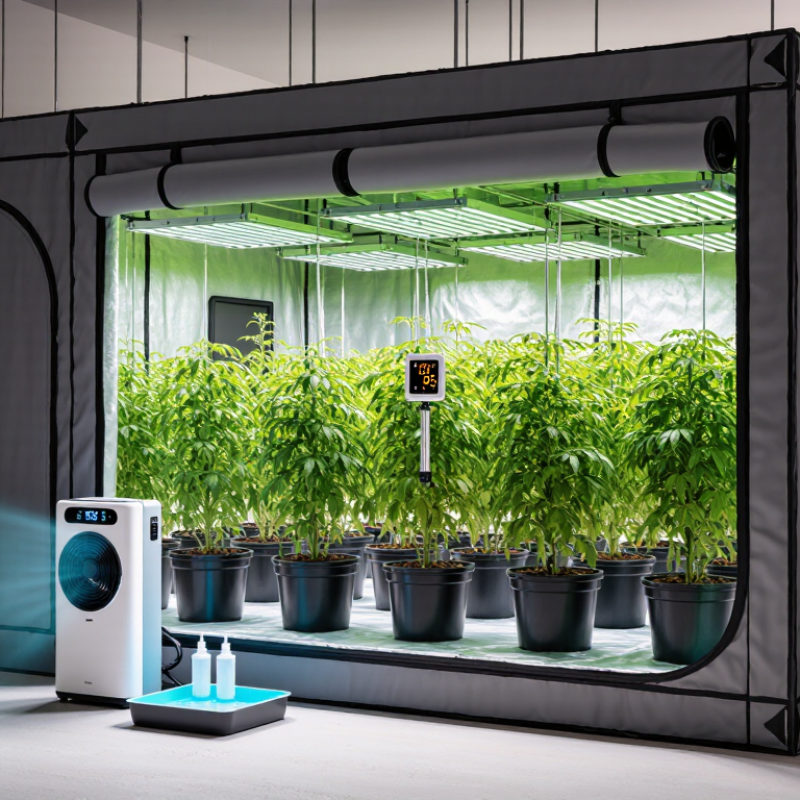
2026 Best Ways How to Keep a Grow Tent Cool in Summer?

Understanding Why Grow Tents Overheat in Summer

Understanding Why Grow Tents Overheat in Summer

A grow tent can become much hotter than the room around it. Its fabric walls hold a small volume of warm air. Lighting equipment adds steady heat above the plant canopy. Fans move air, but they do not remove heat unless that air leaves the tent. During a recent summer setup, I noticed the temperature rose sharply after midday, even with constant circulation. The thermometer reached 32°C near the upper leaves. That area was warmer than the floor.

Several factors create this problem. Hot outdoor air may enter through an intake opening or an overheated room. A weak exhaust path then traps that heat inside. Dusty filters, narrow ducts, and tight bends can reduce airflow more than expected. Humidity also affects plant cooling because moist air slows evaporation from leaves. The sensor position matters. A probe beside the lamp can give a misleading reading, while one hidden below the canopy misses leaf-level stress.

I once blamed the light alone and overlooked the warm room supplying the intake air. That was a poor diagnosis. Measure temperatures at the canopy, floor, and exhaust outlet during the hottest afternoon hours. Check whether air actually travels from the lower intake toward the upper outlet. Reflective walls protect against radiant heat, but they cannot cool the tent. A small tent with powerful equipment may need more careful heat planning than a larger space. Sometimes, the room itself is the real heat source.

Measuring Temperature, Humidity, and Airflow Inside the Tent

2026 Best Ways How to Keep a Grow Tent Cool in Summer?

Measure the tent before changing anything. Place one calibrated sensor at canopy height, another near the floor, and a third beside the exhaust outlet. Readings often differ by 2–4°C. That gap matters. The ASHRAE Handbook—Fundamentals identifies temperature, humidity, and air movement as separate environmental variables. A single wall-mounted sensor cannot describe all three. Record readings every hour during the hottest period, especially with lights operating.

Humidity needs equal attention. The U.S. Environmental Protection Agency recommends indoor relative humidity between 30% and 50%, while ASHRAE generally accepts 30% to 60% for occupied spaces. Plant comfort is different, so avoid treating those ranges as a perfect rule. Calculate vapor pressure deficit when possible. A practical summer target often falls near 0.8–1.2 kPa during active growth, but cultivar response can vary. I once lowered humidity too aggressively and saw leaf edges curl. The temperature looked safe. The air was not.

Airflow should move gently across the canopy, not blast one plant continuously. Controlled-environment agriculture guidance commonly places useful canopy air speed around 0.3–0.6 m/s. Use a handheld anemometer to check several points. Warm pockets behind dense foliage reveal weak circulation. Check exhaust performance with the intake open and then partially restricted; the difference exposes pressure problems. Keep a simple log of temperature, RH, VPD, and air speed. Trends are more reliable than one impressive reading. Even careful measurements can be wrong. Recheck sensors monthly.

Improving Ventilation and Removing Hot Air Efficiently

Summer heat can overwhelm a grow tent within minutes. Start with airflow, not extra cooling equipment. Purdue Extension greenhouse guidance recommends about one complete air exchange per minute, increasing to 1.5 exchanges in very hot conditions. Calculate the target airflow by multiplying tent volume by the desired exchanges per minute. A 4 × 4 × 6-foot tent holds 96 cubic feet. It therefore needs roughly 96 CFM for one exchange, before accounting for duct resistance.

Place the exhaust fan high, where hot air collects. Keep the intake low and unobstructed. This creates a practical vertical airflow path. The American Society of Heating, Refrigerating and Air-Conditioning Engineers notes that airflow performance changes with system resistance, including bends, filters, and long ducts. Choose equipment with a published airflow rating under real static pressure, not only its maximum figure. Use the shortest duct route possible. Seal loose connections.

Add a circulating fan near canopy level. It should move leaves gently, not create constant wind stress. I once treated fan noise as proof of performance. That was a mistake. Check temperature at canopy height and near the tent roof. A digital data logger reveals patterns that a single reading misses. Clean intake screens regularly. A clogged screen can quietly reduce ventilation when heat is highest. Condensation or unstable temperatures may indicate poor exhaust balance, so adjust gradually and record each change.

2026 Best Ways How to Keep a Grow Tent Cool in Summer? - Improving Ventilation and Removing Hot Air Efficiently

Cooling Method Recommended Setup or Calculation Typical Summer Benefit Best Use Case Important Notes
Inline exhaust fan Size the fan for at least one complete air exchange per minute: tent volume in cubic feet × 1 = minimum airflow in CFM. Add approximately 25% to 50% capacity for ducting, bends, and filters. Removes heat and humidity continuously when the fan exhausts air outdoors or into a cooler space. Most grow tents using high-intensity LED or other heat-producing lighting. Use a speed controller or thermostat to avoid excessive drying. Keep the exhaust outlet unobstructed.
High and low air paths Place the exhaust outlet near the tent roof and provide a low-level intake opening with a combined free area at least as large as the exhaust duct area. Uses natural convection because warm air rises, helping the exhaust fan remove the hottest air first. Passive-intake systems and tents located in a naturally cooler room. A slightly negative tent pressure is useful for directing airflow into the tent rather than allowing warm air to leak out randomly.
Active intake fan Use an intake fan rated below the exhaust fan's actual operating airflow so the tent remains slightly negative in pressure. Improves the supply of cooler replacement air when passive intake openings cannot provide enough airflow. Large tents, long intake ducts, or rooms with restricted air movement. Do not draw intake air from an attic, enclosed cupboard, or another hot area.
Oscillating circulation fans Aim airflow across the upper canopy and around the tent perimeter. Use gentle movement rather than a constant strong stream directly on leaves. Reduces stagnant hot spots and improves the uniformity of temperature and humidity. Every tent, especially dense canopies with limited internal air movement. Circulation fans redistribute heat but do not lower room temperature unless warm air is exhausted from the space.
Short, straight exhaust ducting Keep duct runs short, avoid sharp bends, and use the same or larger diameter as the fan outlet. Reduces static-pressure losses so the fan can deliver more of its rated airflow. Any installation where the fan appears weak despite having a suitable rated capacity. Crushed flexible ducting and unnecessary elbows can substantially reduce real-world airflow.
Separate the heat source Use an air-cooled light enclosure or route heat-producing equipment outside the tent when the equipment design permits it. Prevents a significant portion of lamp heat from entering the plant area. Tents operating powerful lights in already warm rooms. All heat removed from the tent must still be discharged outside the room or the room will gradually become warmer.
Run lights during the coolest hours Schedule the lighting period overnight or during the coolest part of the day, while maintaining the required daily light duration for the crop. Reduces the difference between light-on tent temperature and room temperature. Rooms that become hottest in the afternoon. Keep the light schedule consistent; abrupt changes can disrupt plant growth cycles.
Air conditioner or room cooling Estimate heat load using 1 watt of electrical power ≈ 3.412 BTU per hour, then allow additional capacity for the room, people, and equipment. Provides the most reliable reduction in intake-air temperature during extreme outdoor heat. Sealed or semi-sealed rooms where ventilation alone cannot maintain the target temperature. Exhausting hot air into the same room can overwhelm the cooling system unless the room is adequately cooled.
Evaporative cooling Use only where the incoming air is dry and where added humidity can be safely managed. Can lower air temperature through evaporation, but the cooling effect depends strongly on relative humidity. Dry climates with strong exhaust airflow and sufficient humidity-control capacity. Avoid this method in humid conditions because excess moisture can encourage condensation and plant disease.
Temperature and humidity monitoring Place one sensor at canopy height and another near the intake. Check the highest temperature during the light-on period. Identifies hot spots and reveals whether ventilation changes are actually working. All cooling systems, especially automated fan or thermostat controls. A single reading near the floor may not represent the temperature at the plant canopy or tent ceiling.
Practical planning note: Ventilation can remove heat from the tent, but it cannot make the tent cooler than the air being used for intake. For best results, bring in the coolest available air, exhaust hot air as directly as possible, and monitor temperatures at canopy height during the hottest part of the light cycle.

Using Cooling Equipment Without Harming Plant Growth

In summer, keeping a grow tent cool requires balance, not maximum airflow. A digital thermometer and hygrometer should sit near the plant canopy, where heat actually builds. Aim for stable temperatures rather than sudden drops. Many warm-season plants tolerate moderate warmth, but stressed leaves may curl when the air becomes hot and dry. A thermostat can control an exhaust fan, while an intake fan replaces warm air with cooler room air. Keep both fans clear of dust.

Cooling equipment must support plant growth, not fight it. An oscillating fan should move leaves gently without blowing directly on them for hours. Strong airflow can increase water loss and damage tender stems. Portable cooling units may help, but their exhaust must leave the room, or heat will return to the tent. Check humidity after cooling. Colder air often changes relative humidity, and hidden moisture can encourage disease.

Measure plant response daily. Look for dry leaf edges, slowed growth, weak stems, or unusually wet soil. These signs may reveal excessive cooling or airflow. I would not trust one temperature reading; corners and upper tent areas can differ noticeably. Lights-off periods also need monitoring, because temperature swings may shock plants. Cooling is easy to overdo. A slower, measured adjustment is usually safer than chasing a perfect number. Personally, I would review the setup after each hot day, since one missed detail can affect several nights of growth.

2026 Best Ways to Keep a Grow Tent Cool in Summer

Cooling equipment should be sized around the heat produced by the grow light while maintaining stable temperatures for healthy plant growth.

A grow light converts nearly all of its electrical power into heat. The chart uses the standard conversion of 1 watt = 3.412 BTU/h and adds a 20% planning margin for ducting losses, warm summer air, and other small heat sources. Use adequate ventilation, an exhaust fan with a carbon filter, and an appropriately sized air conditioner or evaporative cooler when necessary. Keep the tent temperature within the plant’s recommended range and avoid directing strong cold airflow straight at leaves.

Managing Lights, Watering, and Humidity During Hot Weather

Keeping a grow tent cool in summer starts with controlling light, water, and humidity together. In 2026, efficient lighting still produces heat, even when the fixture feels cool. Raise the light slightly, reduce its daily intensity, or run it during cooler evening hours. Use a timer and check leaf temperature, not just room temperature. A small digital sensor at canopy height gives more useful information.

Water plants early in the day, when roots can absorb moisture before afternoon heat peaks. Check the top layer of growing medium before watering again. Wet soil without airflow can invite root problems. I once watered on a fixed schedule and ignored the leaves. They drooped because the tent was hot, not because they needed more water. That mistake changed my routine.

Humidity needs steady control. In hot weather, strong ventilation may lower humidity too quickly, while frequent watering can raise it overnight. Aim for gentle air movement across the canopy, with no strong wind directly hitting leaves. A dehumidifier outside the tent can help, especially during dark hours. Measure relative humidity near the plants and near the floor. These readings may differ. Keep daytime humidity moderate and avoid leaving wet tools or trays inside. Ventilation settings often need adjustment after weather changes, so inspect the tent daily rather than trusting yesterday’s settings.

FAQS

How much exhaust airflow does a 4 × 4 × 6-foot tent need?

Its volume is 96 cubic feet. Aim for about 96 CFM for one air exchange each minute. Very hot conditions may need 1.5 exchanges, or roughly 144 CFM. Duct bends and filters reduce actual airflow. Check performance under resistance.

Where should the exhaust and intake openings be placed?

Place the exhaust fan high, where hot air gathers. Keep the intake opening low and clear. This creates a vertical airflow path. Shorter ducts usually work better. Seal loose connections.

How strong should the circulating fan be?

Use gentle airflow near canopy level. Leaves should move slightly, not shake constantly. Strong wind can dry leaves and weaken tender stems. I once confused noise with performance. That was wrong.

Where should temperature and humidity sensors sit?

Place sensors near canopy height, where plants actually experience heat. Check the tent roof and corners too. A data logger can reveal patterns that one reading misses. Lights-off temperatures also matter.

Can portable cooling equipment safely cool a grow tent?

It can help when the exhaust leaves the room. Otherwise, the removed heat may return to the tent. Check humidity after cooling. Colder air can change relative humidity and create hidden moisture.

How should lighting change during very hot weather?

Raise the light slightly or reduce its daily intensity. Running lights during cooler evening hours may also help. Use a timer. Check leaf temperature, not only room temperature. A cooler fixture can still warm the space.

When should plants be watered during hot weather?

Water early, before afternoon heat reaches its peak. Check the top layer of growing medium first. Avoid watering by habit alone. I once followed a fixed schedule and misread heat stress as thirst.

How can humidity remain stable during summer?

Use gentle canopy airflow without blowing directly on leaves. Strong ventilation can lower humidity too quickly. Frequent watering may raise humidity overnight. A dehumidifier outside the tent can help during dark hours. Measure humidity near plants and near the floor. These readings may differ.

What signs suggest cooling or ventilation has gone too far?

Watch for curled leaves, dry edges, slowed growth, weak stems, or unusually wet soil. Sudden temperature changes can also stress plants. Adjust one setting at a time. Record each change. Perfect numbers are not always necessary. Stable conditions matter more.

Conclusion

Learning how to keep a grow tent cool in summer starts with understanding why temperatures rise. Outdoor heat, powerful lighting, limited space, and insufficient air movement can quickly create an overly warm environment. Use reliable meters to monitor temperature and humidity at plant level, while observing airflow to identify stagnant areas. A well-planned ventilation system should bring in cooler fresh air and remove hot air from the upper part of the tent. Air circulation inside the space can also help distribute temperature evenly and reduce hot spots.

Cooling equipment may be useful when ventilation alone is not enough, but it should not create harsh drafts or excessive dryness. During hot weather, adjust lighting schedules when practical, reduce unnecessary heat sources, water plants consistently without overwatering, and maintain balanced humidity. Regularly checking conditions and making small adjustments will help protect plant growth and create a more stable, comfortable environment throughout the summer.

Henry

Henry

Henry is a dedicated marketing professional with a profound expertise in the company's offerings. With years of experience in the industry, he possesses an impressive understanding of the market dynamics and consumer behaviors that drive success. Henry is committed to sharing his insights through......